drive&control auf deutsch | Imprint | Terms of Use | Contact | www.boschrexroth.com 

Energy efficiency as a corporate goal

October 2009

Less and less energy in, more and more production out. Can that work? It can. And it must.

The good old-fashioned incandescent light bulb will soon go out forever. Thrifty consumers and demanding legislators have banned it from Europe’s shelves as of 2012. And many more products and technologies are likely to suffer the light bulb’s fate. Because the tolerance of business, society and legislators for energy hogs is evaporating. That’s true in all areas and on all levels, from the standby mode of the home television to the gas-guzzling SUV – and even to complete production facilities.

The TV’s problem can be solved simply by pressing a button. A car can be driven more slowly or occasionally left in the garage. In the case of machines and plant facilities, however, turning them off or leaving them idle are not options. The task here is to achieve the same output and added value with less energy, through intelligent use.

Great potentials and great responsibilities

Dwindling resources, rising energy costs and the need to reduce CO2 output have pushed energy efficiency right to the top of the political agenda. The German Federal Government, for instance, aims to double energy productivity by the year 2020, as compared with 1990. According to the World Energy, Technology and Climate Policy Outlook (WETO) published by the European Commission, industrial manufacturing is the world’s second-largest energy consumer, following only traffic and transportation and accounting for a 35 per cent share. The potential – and the responsibility – for enhanced energy utilization in industry is great.

New technologies and the intelligent use of technologies already on hand can contribute to reaching efficiency goals. In addition to knowledge, skills and creativity, it’s all about attitudes and mindsets. Everyone involved has to really want to achieve set targets and be ready to invest the energy needed to achieve greater output with less energy. This is true particularly for production technology.

Its business divisions and technology sectors cover a broad spectrum and that’s why Bosch Rexroth is integrated into so many industrial processes. The technologies offered (electric drives and controls, hydraulics, pneumatic systems, linear motion technologies and assembly techniques) offer numerous starting points for exploiting energy potentials.

Primary energy | Illustration: Sandra KimmelThe intelligent linking of all actions is key

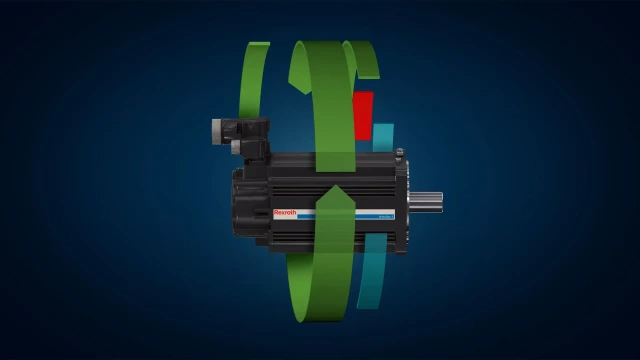
With the development of more energy-efficient components and subsystems, such as efficiency-enhanced pumps and motors or speed-controlled pump drives, it is possible to achieve energy savings of around 15 per cent compared to conventional products. That is good, but not good enough: focusing solely on more energy-efficient components barely scratches the surface of the potential in factory automation. Much greater gains can be achieved through an approach which focuses on the system as a whole. Here, efficient basic components interact with each other to achieve the most direct possible energy flow. In a system optimized in this way, energy is converted on a demand-driven basis, i.e. in the right amount at the moment it is needed.

Besides efficient components, the suite of efficiency “levers” includes optimum design, auxiliary software tools for cycle time and for energy-optimized process step programming, and an overall perspective in mechatronics. What counts is the sum of individual actions, the intelligent linking of multiple principles. Rexroth has bundled and structured the interaction of these levers to achieve the overriding goal of thrifty energy use: Rexroth 4EE – Rexroth for Energy Efficiency.

Comments are closed.